
The 30-day email marketing plan for coaches
A 30-day email marketing plan for a coaching business doesn’t start with writing more emails. It starts with fixing the system underneath them: week 1 plugs your deliverability holes, week 2 revives the subscribers you already paid to get, week 3 rebuilds what you send, and week 4 installs the rhythm that sells.
Your email list is a bucket. You lower it into the well, you haul it up, and by the time it reaches the top there’s barely enough water to sip. Sending more emails to a leaky list is just lowering the bucket faster. So for the next 30 days, we plug holes first and pour water second.
I’ve watched this order of operations produce most of the $15M+ in tracked client sales my campaigns have made. The plan below is exactly what I’d run if you handed me your list on day one, and the number one request behind it came from my own clients: strategy, please, not thirty random content ideas.
Days 1 to 7: plug the holes
Nothing you write matters if it lands in spam. Week 1 is technical, boring, and worth more than any subject line trick:
- Authenticate your domain. Google requires SPF or DKIM from every sender, and DMARC once you send in bulk (5,000+ a day), and mail that fails can be rejected outright. Set up all three anyway; your ESP’s settings page walks you through it in an afternoon.
- Tighten the front door. Add a plain checkbox to your opt-in that says you’ll be emailing often. The wrong people bounce off; the right people make a micro-commitment to open.
- Check the damage. If opens have been sliding, run through the four fixes in why your emails go to spam before you send anything new.
That’s the mistake most coaches make in reverse: they polish the emails and skip the plumbing.
Days 8 to 14: wake the dead
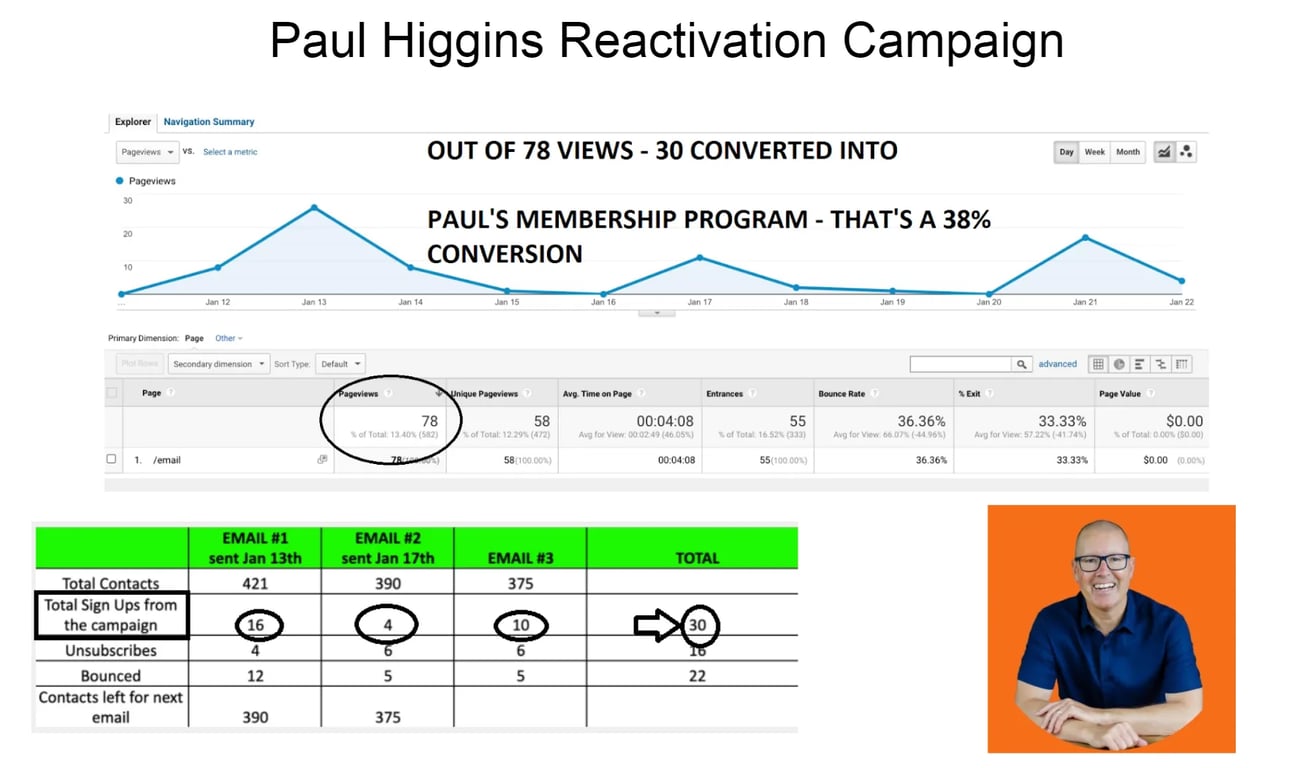
Your cheapest revenue is sitting in the subscribers you already have. Week 2 is a reactivation campaign, and the good news is it’s short:
- Send a reply-based email: one honest, curious question, no links, no pitch. Replies are the strongest positive signal you can send Gmail, and they refill your story bank at the same time.
- Run the dead-list revival sequence on everyone who hasn’t opened in 90 days.
- Let the true non-engagers go. Keeping them to protect a few maybes is stepping over chunks of cash to pick up pennies, and cleaner lists open better.
Days 15 to 21: refill the well
Now, and only now, do we write. Week 3 builds your content engine, ten days of emails from two prompts:
- “Give me the top 10 daily frustrations of [your ideal client].” When I ran this for a niche I’d never written for, the model surfaced compliance as the top headache and produced a story skeleton I’d have needed a week of interviews to find. You rewrite it with your voice and a real anecdote; the story, lesson, offer structure does the rest.
- “List the top 10 reasons someone doesn’t buy from me.” Each objection becomes at least one email. Take time scarcity: nobody has three spare hours, yet if Joe Rogan called, your calendar would clear by lunch. Time objections are priority objections wearing a disguise, and there’s an email in exactly that sentence. Or the confession version: “I told my wife I had no time; she opened my screen-time report, four hours of social media, and handed the phone back without a word.”
Days 22 to 30: earn the sale
The last stretch demonstrates what nobody can copy, and points it at revenue:
- Proof over claims. Client stories with the problem, the wobble and the numbers. A competitor can imitate your tips; they cannot imitate your Tuesday. The information is copyable. The context only you can wrap it in is not.
- Find your cadence and hold it. Daily beats sporadic: MailerLite’s cadence data shows daily senders holding click rates right alongside weekly senders without spiking unsubscribes. Here’s how I’d pick your frequency.
- Open the doorway. Every email gets a soft ask: a P.S., a reply prompt, a link to book. The full selling system lives in how to make money with email marketing, and email’s roughly $36-per-$1 return is why this week exists at all.
After day 30
Let’s recap the four moves: plug the holes, wake the dead, refill the well, earn the sale. The plan compounds from there: the frustration and objection banks refill with every reply, the proof bank grows with every client win, and week five is the natural slot for your first proper promotion. Let an AI system carry the drafting, and keep the whole machine pointed at the plays in the email marketing guide for coaches.
Want the plan delivered as weekly build-alongs with the prompts pre-written? That’s the newsletter. And if not, run the four weeks yourself; the bucket doesn’t care who plugs it.
Watch the full walkthrough
Frequently asked questions
Is email marketing still worth the effort in 2026?
Yes. Litmus pegs email marketing returns at roughly $36 for every $1 spent, and industry projections tracked by HubSpot had global email revenue roughly doubling between 2023 and 2027. The channel is old; the money in it is not.
What if my list has been sitting cold for a year?
Then week 2 is where your plan earns its keep. A reactivation campaign to a cold list regularly out-earns months of new content, because those people already said yes once. Start with a short, curious reply-based email, not an apology essay.
Should AI write these emails for me?
AI should brainstorm the frustrations and objections and draft the structures; you supply the stories, opinions and numbers that make them yours. AI carries assembly, you keep judgment.
What do I sell during the 30 days?
Every email carries a low-pressure doorway (a P.S., a reply prompt, a link), and the plan naturally warms the list for a promotion in week five. Selling hard before the system is fixed is how 30-day plans die on day 12.
Part of the guide: Email marketing for online coaches